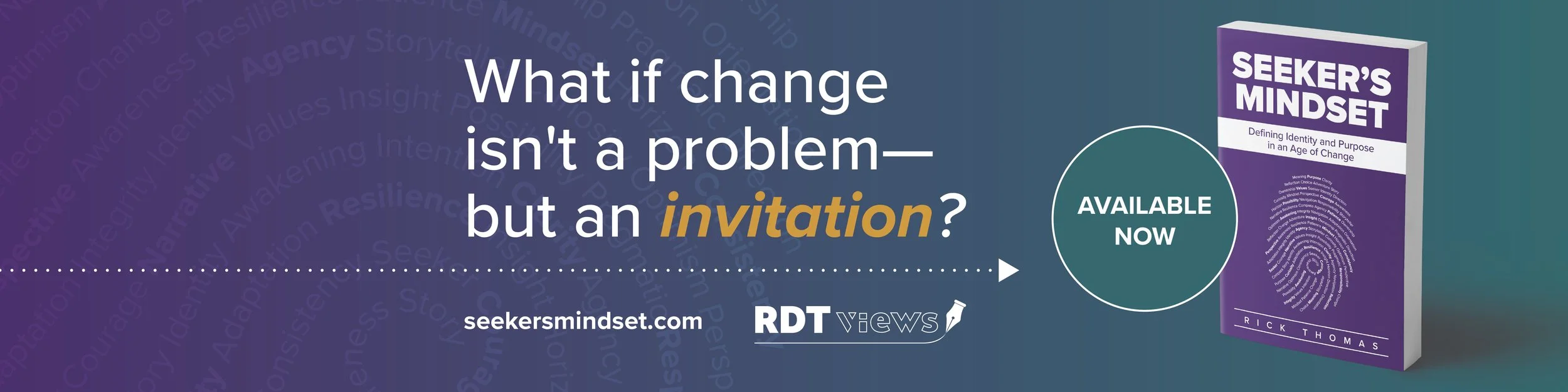
Excerpt from Seeker’s Mindset
Introduction
Over time, even the most subtle earthquakes can reshape the landscapes we travel, altering the opportunities and challenges we encounter along the way—often in ways we don’t notice until the map no longer matches the ground beneath us. The description “subtle earthquake” may seem contradictory—after all, earthquakes shift the earth itself. Yet I can tell you firsthand that not all seismic events announce themselves with violent force. But don’t mistake subtle for insignificant. Even the faintest shift can redirect the course of a river—or the trajectory of a life.
A series of subtle, cerebral “shakers” sparked my fascination with how we experience change—how we interpret it, resist or embrace it, adapt to it, and sometimes are remade by it. At its heart, this book is about the human side of change: what happens within us when the ground shifts beneath us—how those external movements ripple through us, between us, and across the communities we call home—shaping who we become individually and collectively, locally and globally.
Drawing from my own experiences, including living with a learning disability, being a lifelong entrepreneur, and spending nearly three decades living in Alaska and leading a constantly evolving technology company, I explore the patterns that influence whether we resist, stall, adapt, or transform. Our relationship with change doesn’t just shape our mindset; it defines our trajectory and, ultimately, the lives we go on to lead. And in a world that is accelerating and changing at an unprecedented pace, that relationship has never been more critical.
I remember talking with my parents when I was a child about the remarkable changes my grandparents had seen and experienced throughout their lives. It was astonishing to think they were born before the first radio broadcast license was issued in 1920 and, even more astonishing, before the first television broadcast in 1941. I have no doubt that many people today feel the same way about their predecessors. These were the generations that used typewriters, corded phones, and checkbooks—the time before computers, smartphones, Apple Pay and Venmo, and before digital threats required us to be ever vigilant and routinely use multi-factor authentication. It was an era when a picture was worth a thousand words, and audio and video recordings were reliably authentic—before technological advancement imposed a steep, ongoing, and often intimidating digital learning curve.
As each generation adapts to the technologies and norms of its time, the pace of change only accelerates, redefining how we live, work, communicate, and trust. What once felt like gradual progress now arrives as continuous waves of disruption. In recent decades, seismic shifts, some barely perceptible and others profoundly jarring, have transformed the landscape in which we operate. Together, they have opened a widening chasm between the familiar world we once knew—our comfort zone—and an emergent world still taking shape—one we are struggling to fully comprehend and influence.
The tension between nostalgia and the relentless pull of an uncertain future is not only uncomfortable and exhausting, but often disorienting—and threatening. It is ironic, then, that in a period of profound technological advancement, it will not be our technical prowess that determines humanity’s ability to navigate the path ahead. Instead, it will be distinctly human capacities—our ability to adapt, to steady ourselves and our attitudes, to respond constructively to discomfort, and to resolve the conflicts that inevitably accompany change—that will shape the world we create.
End of Introduction Excerpt
If this introduction resonates with you, we invite you to continue the journey in Seeker's Mindset.
Excerpted from Seeker’s Mindset by Rick Thomas. All rights reserved. No part of this excerpt may be reproduced or reprinted without permission in writing from the publisher.